
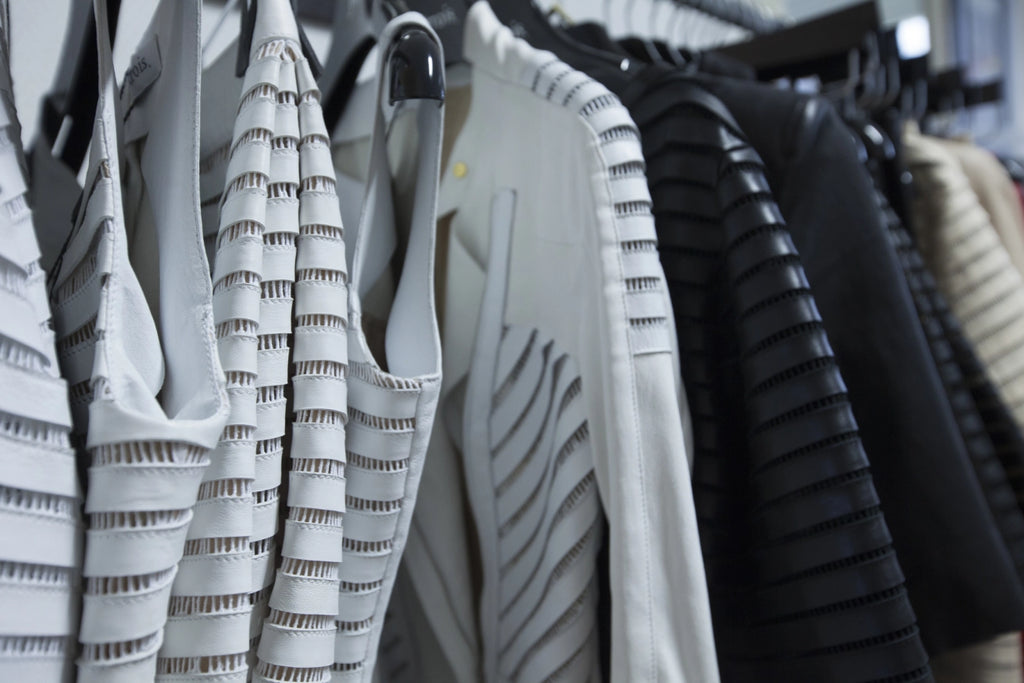
French made leather clothing can describe several realities, which is why it is useful to know the stages of manufacture and where each takes place. Here is how to read the claim, and which questions to ask before buying.
What the claim means, and what it does not
In Europe, the origin of a product rests on the notion of last substantial transformation. In other words, a garment is deemed French when the stage that gives it its essential characteristics took place in France, not necessarily when every stage did.
For a leather garment, that distinction changes everything. A piece may be cut and assembled in France from hides tanned elsewhere. Another may use a leather tanned in the Tarn and then be made up abroad. Both situations exist, they are not equivalent, and neither is legible on the label.
There is also a voluntary label, Origine France Garantie, awarded after an audit by an independent body on criteria of value added in France. Its presence is a reliable signal, its absence proves nothing, since many houses simply do not apply.
The stages that can stay in France
A leather garment goes through four main stages, and each one can sit in a different country.
- Farming and the origin of the hides, which determine the fineness and regularity of the grain
- Tanning and leather dressing, which turn a skin into leather and set its colour and hand
- Cutting, the decisive gesture where the quality of the finished piece is played out
- Assembly, meaning the construction, the seams and the finishing
A brand that seriously claims French craftsmanship can locate those four stages without hesitation. If the detail of that journey interests you, our guide to how leather is made describes each transformation.
The French leather regions
France has no single leather capital, it has specialised areas, inherited from an old geography of water and livestock.
Graulhet, in the Tarn, is one of the historic homes of leather dressing, the working of lamb and goat hides. Millau and Saint-Junien built their reputation on glove making, a craft that demands extremely fine skins. Romans-sur-Isère and Cholet are associated with footwear.
These specialisms are not interchangeable. A dresser who has worked lamb for generations does not practise the same craft as a tanner of heavy hides, and the difference shows in the finished material.
The questions to ask before buying
Three questions are enough to see clearly, and a serious house answers each in one sentence.
First, where the hides come from. A precise origin, a region, a type of farming, that is an answer that commits. Then, where the tanning takes place. Finally, where the piece is cut and assembled, an essential piece of information.
Once those answers are in hand, examining the piece itself confirms or contradicts the story. Our markers for recognising quality leather exist for exactly that, checking with your fingers what the marketing asserts.
Our chain, from the Pyrenees to the atelier
At Jitrois, we have always answered those three questions the same way. Our lamb hides come from the French and Spanish Pyrenees, chosen for the fineness and regularity of their grain. Tanning takes place in France, in the Graulhet region, which lets us control the depth of the colours and the hand of the material.
Cutting and assembly are done by hand, in our Parisian ateliers and in the provinces. That proximity between creation and manufacture is not a posture, it is what makes leather couture possible and, still more, made-to-measure leather clothing, where each piece exists only once.
We draw no moral superiority from it, only a demand for coherence. An exceptional material calls for a rigorous chain, which we follow from the Pyrenees to the atelier, and the page devoted to the leather of the House sets out that journey stage by stage.
Frequently asked questions
How can you tell whether a leather garment is genuinely made in France?
By asking three precise questions. Where do the hides come from, where are they tanned, and where is the piece cut and assembled. A brand that controls its chain names the places of each stage, from the hides to the final assembly.
Is leather tanned in France enough to claim French manufacture?
No. Tanning is an important stage but it is not the making of the garment. A hide can be tanned in France and then cut and assembled on the other side of the world. Conversely, a piece assembled in France may use imported hides. Both pieces of information are useful and should be asked for separately.
Which is the leather capital of France?
There is no single one, but several specialised areas. Graulhet, in the Tarn, is a historic centre for the dressing of lamb and goat hides. Millau and Saint-Junien are associated with glove making, Romans-sur-Isère and Cholet with footwear. Each area developed skills that are not interchangeable.
Is there a label for clothing made in France?
Yes, the Origine France Garantie label is awarded after an audit by an independent body, on criteria of value added in France and of the product’s essential characteristics. Not every brand manufacturing in France applies for it, so its absence proves nothing. It remains a useful marker when present.