
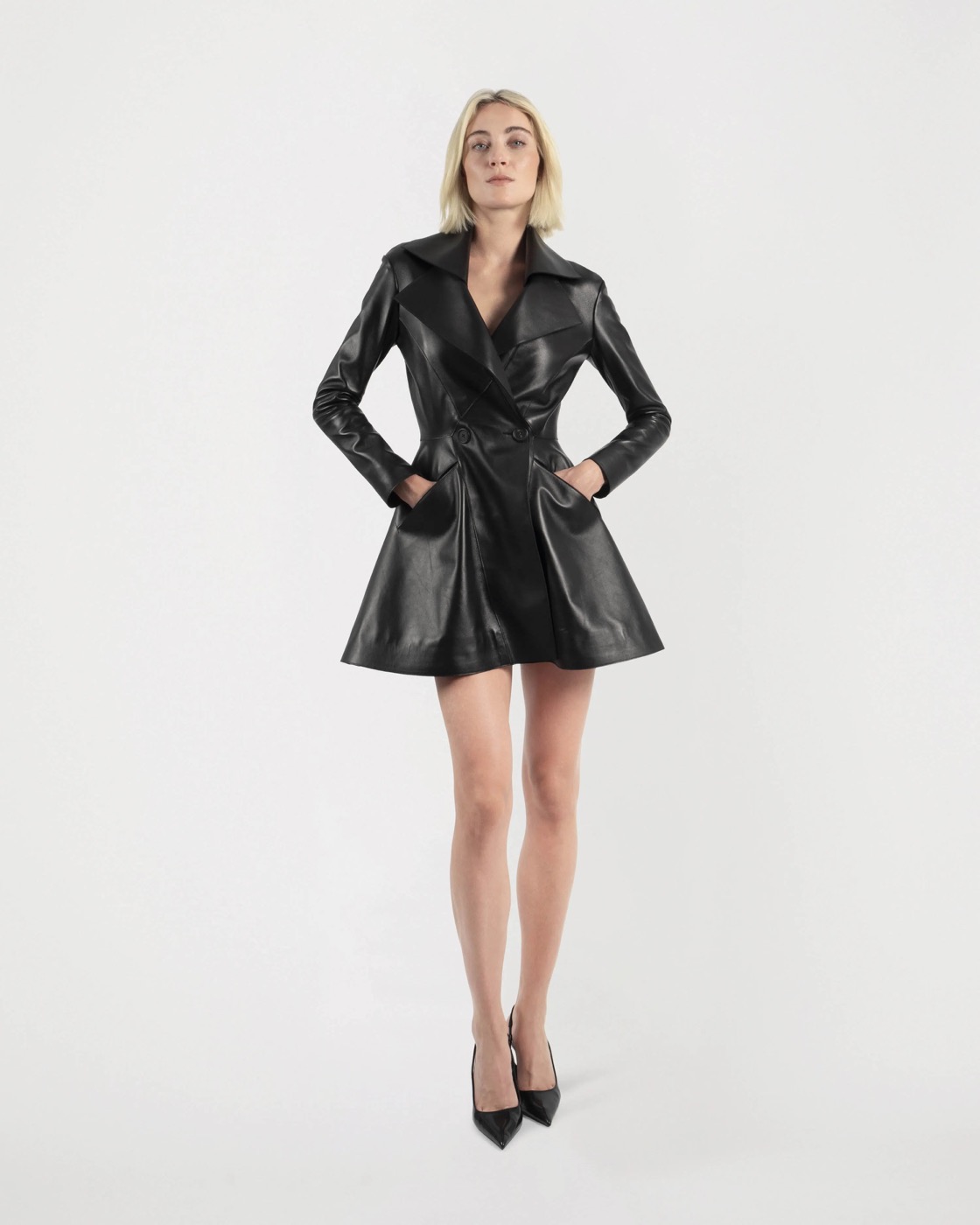
Paris remains the capital of a craft few cities still practise at this level. To speak of the greatest French couture houses is to speak of ateliers, of gestures handed down and of silhouettes that marked their era. Here is how we read that heritage, from our own ground, which is leather.
What the haute couture label really covers
Contrary to what common usage suggests, haute couture is not an adjective of prestige but a term protected by French law. A house does not declare itself haute couture, it is authorised to use the name.
The conditions concern real work, not turnover. They require an atelier in Paris, a workforce dedicated to making, collections presented twice a year and pieces made to measure for private clients. The list of authorised houses is reviewed regularly, which is why it shifts from one season to the next, with established members and invited houses.
That requirement has a direct consequence. Several of the most powerful French houses are not part of it, simply because their history begins elsewhere, in trunks, saddlery or perfume. We set out that frontier in our comparison of haute couture and ready-to-wear.
The houses that wrote this history
A handful of names structure the story of French couture. Not because they sell the most, but because each one moved something.
| House | Marker | What it brought |
|---|---|---|
| Lanvin | 1889 | The oldest French house still in activity |
| Chanel | 1910 | A liberated silhouette, tweed, black raised to a colour |
| Balmain | 1945 | The sculpted post-war line |
| Dior | 1947 | The New Look and the return of a marked waist |
| Givenchy | 1952 | A pared-back chic, an elegance of line |
| Saint Laurent | 1960s | The tuxedo for women and luxury ready-to-wear |
| Jean Paul Gaultier | 1976 | Irreverence brought into couture |
The table does not say everything, and does not claim to. Other houses matter, Schiaparelli and its Parisian surrealism, or the contemporary houses that keep the couture calendar alive today. But these seven names are enough to grasp the movement, each having brought an idea that outlived its founder.
What actually makes a great house
From spending time in ateliers, we ended up isolating four markers that recur in every house that lasts.
The first is a founding gesture. A great house is often born from an intuition that seemed daring at the time. The suit for women, the marked post-war waist, the female tuxedo, each one shocked before it was adopted.
The second is a material the house knows better than anyone. Tweed for one, pleating for another. That intimate knowledge eventually becomes a signature recognisable without a label.
The third is a living atelier, with hands that know how. A living atelier is what sustains a house’s creative ability, and the great houses have kept theirs.
The fourth is transmission: the houses that cross a century hand their language to other designers with fidelity. The history of leather in fashion offers a good vantage point on those handovers.
The place of specialist houses
Not every French house sets out to cover the whole wardrobe. Some have chosen one material and devote their entire craft to it, which is another way of being a couture house.
That is our case. Maison Jitrois does not belong to the haute couture calendar, and we have no reason to suggest otherwise. What we claim is more precise. In the 1980s, Jean-Claude Jitrois applied couture codes to a material fashion had reserved for utilitarian clothing, with sculpted leather dresses, shoulder volumes and marked waists. Then, in the early 1990s, the invention of stretch leather allowed the skin to follow the body like a second skin.
That is where the discipline we call leather couture comes from, with its patterns, its hand cutting and its made-to-measure work. A specialism we own rather than a generalist ambition, whose stages are retraced in the heritage of the House.
Frequently asked questions
Which is the oldest French couture house still in activity?
It is Lanvin, founded by Jeanne Lanvin in 1889. The house began with children’s clothing before extending to women’s and then men’s wardrobes. That longevity makes it a rare case in French couture.
What gives a house the right to use the term haute couture?
In France the term is legally protected and cannot be used freely. It is granted to houses that meet precise conditions, among them an atelier in Paris, a dedicated workforce, collections presented twice a year and pieces made to measure for private clients. The list of authorised houses is reviewed regularly, which is why it changes from one year to the next.
Are all the great French luxury brands haute couture houses?
No, and the confusion is common. Several of the most powerful French houses do not belong to haute couture, because they were born from leather goods, trunk making or perfume rather than from a couture atelier. Being a great French house and being a haute couture house are two distinct things.
Who are the great French couturiers?
The names that come up most are Jeanne Lanvin, Gabrielle Chanel, Christian Dior, Pierre Balmain, Hubert de Givenchy, Yves Saint Laurent and Jean Paul Gaultier. Each left an identifiable gesture, a silhouette or an idea that moved the fashion of its time, well beyond a single successful collection.