
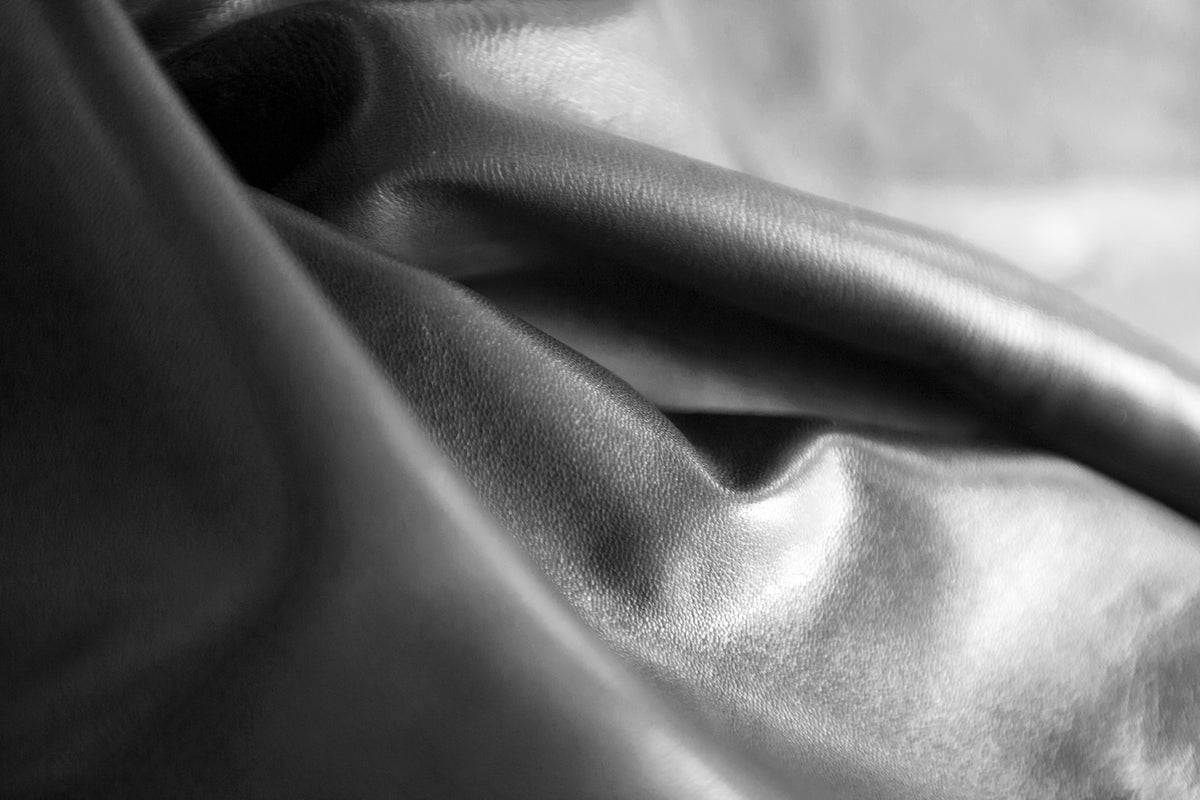
Not every hide tells the same story. Lambskin leather holds a particular place in the luxury wardrobe, that of a material fine enough to be cut like a cloth and noble enough to carry a couture piece. It is the skin we have always worked with, and here is why.
What lambskin leather actually is
Lambskin comes from the hide of a young animal, which explains most of its qualities. Its fibres are finer and tighter than those of an adult skin, and the grain layer, the surface that gives leather its look, is remarkably even.
A lamb hide is measured in tenths of a millimetre. It weighs little, folds without breaking, and lends itself to volumes that heavy leathers rule out. That lightness is not a matter of comfort alone, it governs everything a couturier can do with the material.
Nor is lambskin a single material. Depending on the finish, the same hide becomes a smooth nappa, a plongé lamb dyed to the core or a velvety suede. Our piece on nappa leather explains this family of soft finishes, very often produced on lamb.
What sets lamb apart from other leathers
Leather vocabulary invites confusion. A few markers are enough to find your way.
| Hide | Thickness and hand | Natural use |
|---|---|---|
| Lamb | Fine, light, very supple | Couture clothing, dresses, close-fitting jackets |
| Sheep | Thicker, more pronounced grain | Warm clothing, shearling |
| Calf and cowhide | Thick, firm, resistant | Leather goods, footwear, structured jackets |
| Goat | Fine, visible grain, springy | Gloves, small leather goods |
The gap between lamb and cowhide is the one that matters most. Cowhide builds a shape, it stands upright and remembers its structure. Lamb, by contrast, embraces. It follows the shoulder, marks the waist, falls without breaking. A couturier who wants to sculpt a silhouette chooses lamb, a saddler will choose cowhide.
What we look for in a beautiful hide
Not all lamb hides are equal, far from it. Three criteria make the difference.
The first is the regularity of the grain. An uneven hide forces whole areas to be set aside at the cutting stage, which makes the finished piece more costly and its appearance less homogeneous.
The second is the hand, the workshop word for how a skin feels between the fingers. A beautiful lamb hide is supple without being limp, dense without being stiff. It springs back when you release it.
The third is how the colour holds. A surface-dyed leather reveals itself at the first fold, where the shade turns paler. A hide dyed through keeps its depth everywhere. Our markers for recognising quality leather set out these simple gestures, all of them usable in a boutique.
Durability, and what it really depends on
This is the question we are asked most often. Lambskin is indeed more delicate than a heavy bovine leather. Its fineness makes it more sensitive to hard friction and to snags.
But the life of a leather garment does not rest on thickness alone. It depends on the quality of the raw hide, on the seriousness of the tanning and on the way the piece is assembled. A jacket cut from an exceptional skin and put together by hand crosses the years and takes on a patina nothing else replaces. A piece cut from a mediocre hide tires quickly, whatever its thickness.
The road from raw hide to garment therefore matters as much as the hide itself, and we followed it step by step in our guide to how leather is made.
Where our hides come from
At Jitrois, selection begins long before the atelier. Our lamb hides come from the French and Spanish Pyrenees, a source recognised for the fineness and regularity of its grain, and for the ability of its skins to become supple without losing their hold.
Tanning takes place in France, in the Graulhet region, one of the historic homes of French leather dressing. That proximity lets us control the depth of the colours, the hand of the material and the way it behaves once worn.
This demand on the material is what makes leather couture possible, the discipline we practise. It also made our best-known invention possible, stretch leather, where the grain side of a plongé lamb is bonded onto a cotton and Lycra base so that the leather follows the body like a second skin. The page devoted to Jitrois leather returns in detail to that chain, from the hide to the finished piece.
Frequently asked questions
Is lambskin a good quality leather?
Lambskin is one of the most sought-after hides in luxury clothing. Its grain layer is fine, its texture regular, its hand supple and light. That fineness allows a precision of cut and a drape that thicker leathers do not permit. At Jitrois, we work with hides from the French and Spanish Pyrenees, chosen for the regularity of their grain and their ability to stay stable over time.
What is the difference between lambskin and calfskin or cowhide?
Cowhide comes from an adult animal, so it is thicker, firmer and more resistant to abrasion. Lamb is a young skin, therefore finer, lighter and far more supple. Cowhide builds a garment that stands on its own, lambskin accompanies the body. That is why leather goods favour cowhide and couture favours lamb.
What is the difference between lambskin and sheepskin?
Lamb and sheep belong to the same species, but not to the same age. A lamb hide is taken from a young animal, making it finer, denser and more even. Sheepskin, more mature, shows a more pronounced grain and a looser hand. In couture clothing, the gap is felt immediately in the touch and in the way the material falls.
Is lambskin leather durable?
It is more delicate than a heavy bovine leather, which is the counterpart of its fineness. Its longevity depends less on thickness than on the quality of the original hide, the tanning and the assembly. A piece cut from a beautiful lamb hide and assembled by hand is worn for years, and even gains character along the way.