
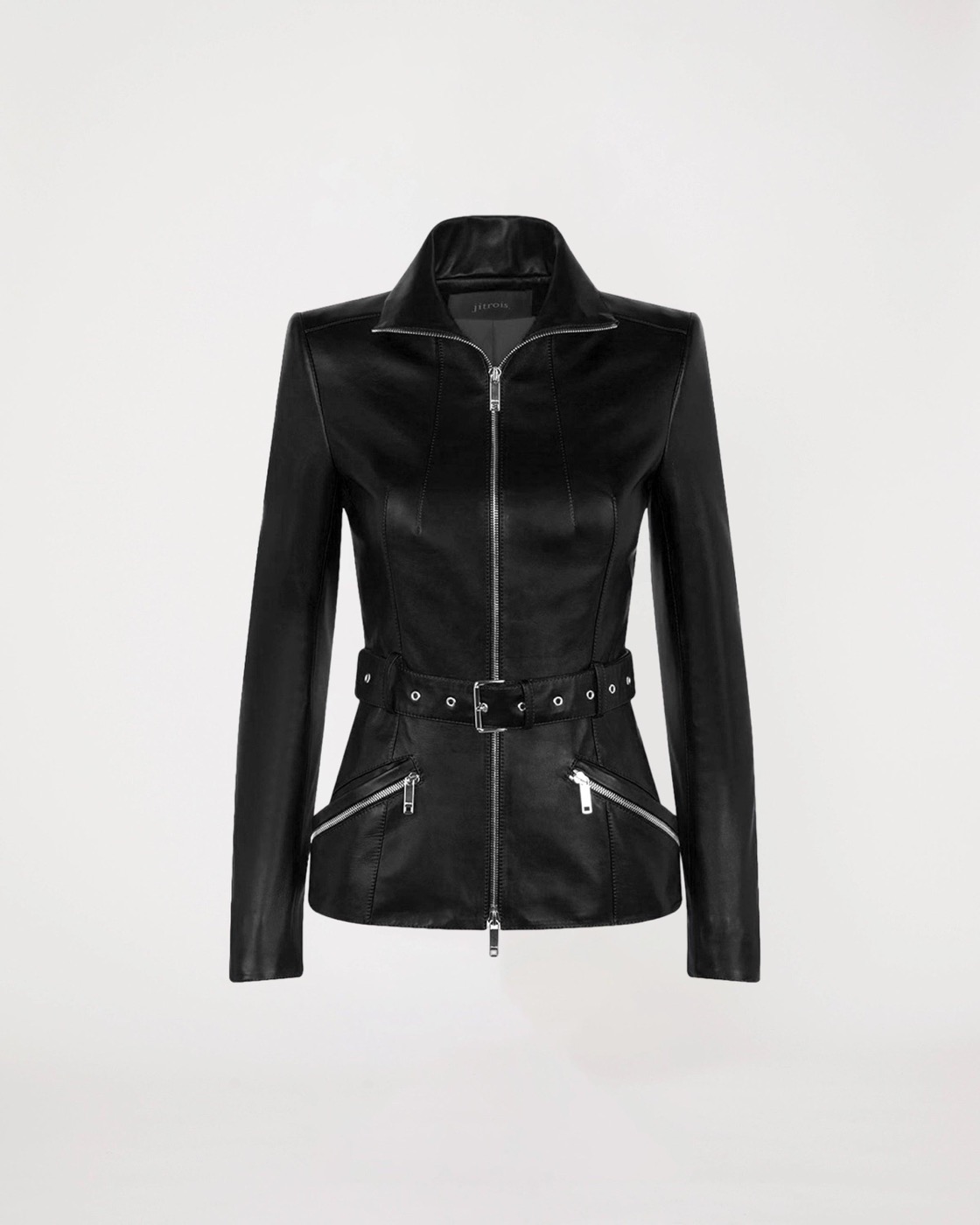
Two leather jackets, two pairs of leather trousers, sometimes twice the price for one over the other, and the same question every time. What really separates a piece in stretch leather from one in classic leather? The answer has nothing to do with prestige, since both are genuine leather. It has everything to do with what each material allows you to wear, and how it ages on you.
In brief
- Classic leather is a hide on its own, 0.6 to 1 mm thick. Stretch leather is a hide split down to 0.2 or 0.3 mm and bonded to an elastic knit.
- The first slackens where it works and keeps that deformation. The second extends, then returns to its original shape.
- This difference decides which cuts are possible. A close-fitting piece is only genuinely wearable in an extensible material.
- The price gap comes from the making, not from the margin. The hide loses 30 to 40 per cent of its surface during heating.
- Each material has its territory. Classic leather for structured outerwear, extensible leather for everything that follows the silhouette.
Two constructions, two behaviours
Classic leather is a tanned hide, assembled as it is. Its suppleness depends on the animal, the tanning and the thickness retained. It softens with wear, but it does not stretch, and above all it never comes back.
Extensible leather is a construction. The grain of the hide, its original surface, is thinned to the extreme and then bonded under heat to a cotton and elastane backing. The skin takes on the behaviour of the textile, extending when called upon and returning when released. We set out this process in our article on stretch leather, from splitting to bonding.
Hold on to that principle, it explains everything else. In one case the material endures the movement of the body. In the other it follows it.
What the difference changes in wear
How it holds over time
This is the most tangible point, and the most visible after a year. Classic leather deforms at flex points, knees, elbows, seat. Those bags never come out, they are part of the life of the material, and some outerwear even gains character from them.
An extensible material does not take them. The elastic backing returns the skin to its original position every time. A pair of trousers keeps its line after a hundred wears, which changes the way you look at the investment entirely.
Freedom of movement
Close-fitting classic leather restricts movement. That is why leather long remained confined to jackets and coats, cut loose to let the body breathe. Tighten the cut and the material makes itself felt with every step.
Extensible leather removes that constraint. It follows you as you sit, walk or raise an arm, without ever pulling. That comfort is precisely what made a leather wardrobe wearable every day rather than reserved for outerwear.
The cuts it allows
For a designer, the gap is more radical still. A material that does not move imposes volumes, darts and ease. A material that follows the body allows the exact line, that of the leather couture we practise, where leather is worked like a couture fabric.
That reversal is what brought the dress, the skirt, the jumpsuit and trousers into the leather repertoire. Without an extensible material these pieces exist, but they wear badly.
The differences at a glance
| Deciding factor | Stretch leather | Classic leather |
|---|---|---|
| Comfort in a close cut | High, the material follows the movement | Low, movement is restricted |
| Condition after a year | Original line preserved | Bagging at knees and elbows |
| Cuts available | Close to the body, second skins | Structured volumes, roomy pieces |
| Natural pieces | Trousers, skirt, dress, jumpsuit | Jacket, coat, structured outerwear |
| Ageing | Stable hold, even appearance | Pronounced patina, material that loads up |
| Price level | Higher, driven by the making | More accessible at equal hide quality |
| Craft required | Rare, the cut follows the direction of stretch | Widespread |
Which material for which piece
The question is not which one is better, but which one suits what you are looking for.
For a jacket or a coat, classic leather remains relevant. These pieces are worn with ease, they work very little, and the thickness of the hide gives them the shoulder that makes their allure. Too fine a material would lose that structure.
For trousers, a skirt, a dress or a jumpsuit, extensible leather is the natural choice. These are the pieces that follow the body all day, and the slightest stiffness is paid for immediately. It is also where classic leather marks first. Our guide to wearing leather trousers returns to what this material allows in terms of cut.
For a piece you will keep for years, look at the hide first. A well-selected plonge lambskin, whose most refined finish is nappa leather, remains the best starting point, extensible or not.
Why the price gap
A piece in extensible leather costs more, and that is explained by facts of manufacture rather than by positioning.
The hide shrinks by 30 to 40 per cent when it is heated before bonding. Far more material has to be bought than the finished surface suggests. Splitting to a tenth of a millimetre, next, forgives nothing. A scar invisible on a thick hide goes right through a thinned one, so only a fraction of the available skins qualify.
Then there is the cut. Working a material that stretches in one direction only calls for a craft few ateliers still practise. At Jitrois, every piece is cut and assembled by hand in France, from hides tanned in the Tarn. That is what we describe on our materials page.
Checking what you are being sold
Look at the reverse of the leather, an authentic stretch material reveals a fine, even knit pressed against the skin. Be wary of an elastane lining, which gives the garment suppleness while the leather still marks like any other. Finally, stretch the material, it should come back on its own and leave no trace.
These habits apply to any leather piece, and we have gathered them in our guide to recognising quality leather.
Choosing between the two materials therefore comes down to choosing a use. Classic leather dresses the body, extensible leather accompanies it. Our leather trousers show what the second allows, a close cut that stays comfortable from morning to evening.
Frequently asked questions
What is the difference between stretch leather and classic leather?
Classic leather is a hide on its own, 0.6 to 1 mm thick, that does not stretch. It slackens at flex points and eventually bags at the knees and elbows. Stretch leather is a hide split down to 0.2 or 0.3 mm and then bonded to an elastic knit. It extends under tension and returns to its original shape. The first imposes its form on the body, the second follows the movement.
Is stretch leather more comfortable than classic leather?
Yes, on close-fitting pieces. Trousers, a skirt or a jumpsuit in classic leather restrict every movement, which is why they have to be cut loose. Stretch leather follows the body, so sitting down and walking take no effort. On a jacket or a coat, pieces that are roomy by nature, the difference in comfort is far less noticeable.
Is stretch leather more fragile than classic leather?
No, it simply ages differently. Classic leather develops a patina but keeps whatever deformation it has taken. Stretch leather, although thinner, holds its original line wear after wear because the elastic backing dictates its behaviour. Longevity depends on the quality of the hide and the assembly, not on thickness.
Why does stretch leather cost more?
Because it consumes far more raw material. The hide shrinks by 30 to 40 per cent during the heating stage that precedes bonding, so close to 40 per cent more skin must be committed for the same finished surface. Add to that a splitting operation accurate to a tenth of a millimetre that tolerates no flaw, and a cut that has to account for the direction of stretch.
Which leather should I choose for trousers?
Stretch leather, without hesitation. Trousers are the piece that works hardest, at the knees and when seated, and that is exactly where classic leather marks first. An extensible material allows a close cut that stays comfortable and keeps its line, which is not achievable otherwise.