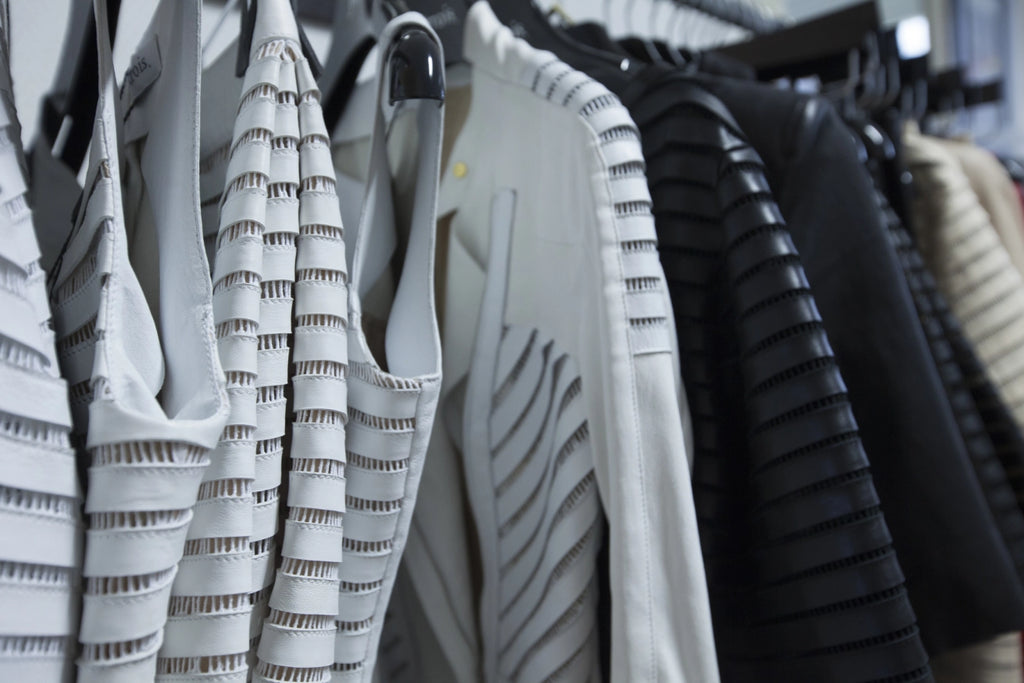
 © Jitrois
Standing in front of a piece of stretch leather, the first question is almost always the same. Is this really leather? The material extends like a jersey, follows the line of the body, and that unexpected behaviour raises doubts. The answer is yes, and the explanation lies in a technical gesture of rare precision. This material sits at the foundation of our craft, so here is exactly what it is, how it comes into being, and how to recognise it.
In brief
- It is a genuine skin, usually lambskin, split down to 0.2 or 0.3 mm, roughly the thickness of a sheet of paper.
- That skin is heated, then bonded onto an elastic textile backing combining cotton and elastane.
- The resulting material lengthens across the width, then instantly returns to its original shape.
- It marks neither at the knees nor at the elbows, unlike traditional leather which deforms wherever it works.
- It emerged in the 1980s from an encounter between a couturier and a French tanner, and founded the leather couture we have practised ever since.
A definition
It is genuine leather made elastic through its union with an extensible textile. Nothing more, nothing less. The skin is not chemically altered to become supple, it is thinned to the extreme and then bonded to a knit that lends it its elasticity.
The term therefore covers two materials in one. On one side the grain of the hide, that dense and regular original surface which gives leather its texture and its light. On the other a textile backing, most often a blend of cotton and elastane, invisible once the piece is assembled. The two become one after bonding, and behave from then on as a single material.
Lambskin dominates because it offers the finest and most supple hide available. Its noblest finish, nappa leather in plongé lambskin, forms the working base of demanding houses.
How a hide becomes extensible
The process comes down to three gestures, none of which forgives a mistake.
The skin is first split, meaning it is separated through its thickness so that only the upper layer remains. It is taken down to 0.2 or 0.3 mm, where garment leather ordinarily sits between 0.6 and 1 mm. At that stage the skin is translucent, you could read a newspaper through it. One hesitation from the machine and the material is lost.
It is then heated. This is the stage nobody suspects, and it explains almost everything about the price of the material. Under heat the skin contracts sharply, losing 30 to 40 per cent of its surface.
It is finally bonded onto the elastic backing, hot, under press. The shrunken leather and the tensioned knit are joined, and the skin permanently adopts the behaviour of the textile. It lengthens when called upon, and returns when released.
Then there is the direction of movement. The material does not stretch every which way, it works mainly across the width. That constraint governs the entire cut. A piece designed without accounting for it will give where it ought to hold, and hold where it ought to follow. This is where the cutter’s skill decides the final quality, far more than the hide itself.
What separates stretch leather from classic leather
| Extensible leather | Traditional leather | |
|---|---|---|
| Thickness of the hide | 0.2 to 0.3 mm | 0.6 to 1 mm |
| Structure | Skin bonded to elastic knit | Skin alone |
| Behaviour | Lengthens, then recovers | Slackens without recovering |
| Wear over time | No marking at flex points | Bagging at knees and elbows |
| Cut | Close to the body, line preserved | More constructed volumes |
| Natural use | Trousers, skirts, dresses, jumpsuits | Blousons, coats, structured pieces |
The distinction is not a matter of comfort alone. Traditional leather imposes its shape on the body, extensible leather does the reverse. That reversal is what made a fitted leather wardrobe possible, from leather trousers to the evening dress, at a time when leather remained confined to outerwear.
Recognising genuinely extensible material
The word is used broadly, including for pieces that do not qualify. Three checks are enough.
Look at the reverse. Authentic material reveals its textile backing, a fine and regular knit pressed against the skin. If the reverse looks brushed or foamy, you are dealing with an imitation.
Look for the lining. Some pieces advertise stretch when all they offer is classic leather mounted on an elastane lining. The give then comes from the garment, not from the material. The leather itself will not extend by a millimetre, and will mark like any other leather.
Stretch it and let go. Genuine material lengthens clearly under the hand, then returns on its own without holding a trace. An imitation stays stiff, or keeps the deformation.
Why this material costs more
The price of an extensible leather garment often comes as a surprise. It rests on simple facts.
Shrinkage, first. Since the skin loses up to 40 per cent of its surface under heat, far more raw hide must be committed to obtain the same finished surface. A hide bought is never a hide used.
Selection, next. Splitting to a tenth of a millimetre forgives no flaw. The slightest scar or irregularity travels through the thinned skin and becomes visible. Only a fraction of available hides withstands the treatment, and that fraction is paid for.
The cut, finally. Working a material that moves demands a craft few ateliers still hold. At Jitrois, every piece is cut and assembled by hand in France, from hides tanned in the Graulhet region. That is what we mean by the leather of the House.
A material born of an encounter
It did not come out of a laboratory. In the 1980s, Jean-Claude Jitrois was searching for a leather able to follow the body rather than constrain it. He found his counterpart in a tanner from the Tarn, Manuel Saussol of Cuirs du Futur, who developed the bonding process. The elastic backing draws on Lycra, the fibre developed by DuPont de Nemours.
From that meeting between a couturier’s intuition and a tanner’s mastery came a material that did not exist, and with it a way of drawing leather. It is the starting point of our heritage, and the reason we speak of a second skin rather than a garment.
Frequently asked questions
Is stretch leather real leather?
Yes. It is a genuine skin, usually lambskin, split down to a thickness of 0.2 to 0.3 mm and then bonded onto an elastic textile backing. The grain, the original surface of the hide, remains visible and intact. It is neither an imitation nor a synthetic material, it is leather that has been given the ability to extend.
What is the difference between stretch leather and classic leather?
Classic leather measures between 0.6 and 1 mm and does not stretch. It only slackens at the points where it flexes, and eventually marks at the knees and elbows. Extensible leather is split far more finely and bonded to an elastic knit, which allows it to lengthen and then return to its original shape. One dresses the body, the other moves with it.
Why does a stretch leather garment cost more?
Because much of the raw material is lost along the way. The skin shrinks by 30 to 40 per cent when heated ahead of bonding, so close to 40 per cent more hide must be committed to obtain the same finished surface. Add to that splitting accurate to a tenth of a millimetre, which allows no margin for error, and a cut that must account for the direction of stretch.
Who invented stretch leather?
The material came out of an encounter between couturier Jean-Claude Jitrois, who was looking for a leather able to follow the body, and tanner Manuel Saussol of Cuirs du Futur, a tannery based in Graulhet in the Tarn, who developed the bonding process. The elastic backing relies on Lycra, the fibre developed by DuPont de Nemours. Maison Jitrois made it its signature from the 1980s onwards.
Does stretch leather lose its shape over time?
No, and that is precisely what sets it apart. Traditional leather deforms wherever it works, at the knees and elbows, and never recovers. Here the elastic backing dictates the behaviour of the skin, the material lengthens under strain and then returns to shape. The original line is preserved wear after wear.